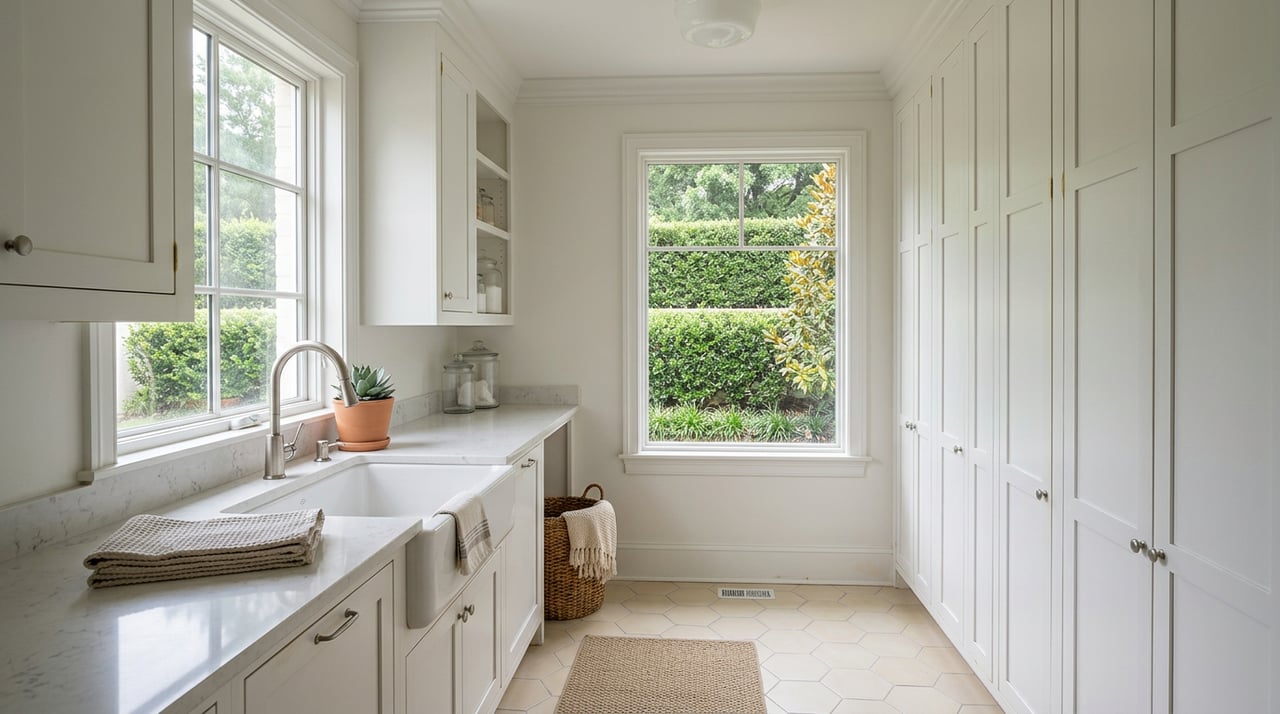
What "No MUD Tax" Doesn't Tell You About Benders Landing Estates
A lot number and a section name can change your closing costs in Benders Landing Estates, and most buyers don't find that out until the title company asks which of three associations governs their parcel. The listing said "no MUD tax." It didn't say which HOA sends the bill, what the resale certificate costs, or whether the lot sits on public sewer or a private septic system. Those details don't show up in the marketing copy, and they add up to real money.
Walk through builder sites, agent write-ups, and neighborhood overviews for this community and you'll read the same sentence over and over: no MUD tax. It's a genuine selling point. Municipal Utility Districts are common across Houston-area subdivisions, and their debt-service assessments can add a substantial line to an annual bill. A community that skips that line has a real cost advantage over one that doesn't.
The problem is that this single fact has become the whole pitch. It's repeated as if it settles the affordability question on a property that is, in practice, anything but simple to price out. Benders Landing Estates spans thousands of acres across multiple sections, and the "no MUD" line tells you nothing about what governs those sections once you're past the sales office.
Benders Landing, Benders Landing Estates, and the gated Castle Court section are marketed together as one community, but they sit under separate legal umbrellas. Public HOA registries list Benders Landing Property Owners Association and Benders Landing Estates Property Owners Association as distinct entities, and a third association, Crossroads at Benders Landing Estates HOA, governs its own section. Each files its own management certificate with the state, and each one charges its own resale certificate fee before a sale can close.
That fee runs $375 for both of the two POAs with public fee data on file, according to HOA registry records. Annual dues aren't uniform either. Public listing records for the original Benders Landing section show dues running roughly $920 to $1,500 a year, while listings in Benders Landing Estates run closer to $1,250 to $1,575 a year. Two homes marketed under the same community name can carry a few hundred dollars a year of difference before you've factored in anything else.
| What varies by section | Why it matters |
|---|---|
| Which of three HOAs governs the lot | Determines who issues your resale certificate and deed restrictions |
| Resale certificate fee | Confirmed at $375 for two of the three associations |
| Annual HOA dues | Roughly $920-$1,500 in one section, $1,250-$1,575 in another |
| Architectural control rules | Set separately by section, including tree removal and setbacks |
Here's where the marketing gets genuinely confusing. Even though "no MUD tax" holds true across the community, the actual rate quoted for Benders Landing Estates isn't consistent from one source to the next. One site advertises $2.07 per $100 of appraised value. Another cites 1.94 percent. A homeowner review on a public real estate site references 1.598 percent, for what reads like the same neighborhood.
None of these figures are necessarily wrong. They likely reflect different sections, different tax years, or whether a homestead exemption had already been applied before the number was calculated. For context, Montgomery County's overall median effective property tax rate runs about 1.36 percent as of the county's most recent published trend data. Every figure quoted for Benders Landing Estates sits above that county median, and the spread between the low and high numbers is real money on a home priced in the mid six figures or higher.
The takeaway isn't that any one source is lying. It's that a marketing rate is not the same thing as a tax bill. Before you compare this community to another, ask for the current year's actual bill on the specific parcel, not the number on a builder's landing page.
The split that surprises buyers most often isn't tax related at all. Some lots in Benders Landing Estates tie into public water and sewer. Others require a private aerobic septic system. Which one serves a given parcel affects both what you can build on it and what you'll pay to keep it running.
Aerobic systems need electricity to run the aerator that treats wastewater, and most require ongoing maintenance that homeowners commonly budget around $200 to $350 a year. Installation costs run higher than a standard system. The EPA's overview of septic system types notes that aerobic treatment units function much like a small-scale municipal sewage plant, which is exactly the added complexity a public sewer line spares you. A power outage that's a minor inconvenience on public sewer becomes a household management problem on an aerobic system, since the tank can't treat or pump wastewater without power.
This isn't a mark against the community. Acreage living in South Montgomery County comes with utility variation built in. It's a reason to confirm which type serves your specific lot before you write an offer, not after the inspection turns up a system you weren't expecting.
Castle Court is the one gated section within Benders Landing Estates, built around 1-plus acre lots, a private sitting park, an entrance monument, and gated access through an EZ Tag system. That's a real amenity difference, and it's priced differently than the ungated sections around it. Architectural control rules, tree preservation requirements, and construction review timelines vary by section too, so two homes on adjoining streets in Benders Landing Estates can operate under different rules even though both carry the same name on the entrance sign.
If you're weighing Benders Landing Estates against another gated or acreage community in the area, the number that matters isn't "has a MUD" or "doesn't have a MUD." It's the total of HOA dues, resale certificate fee, the actual current tax bill for that exact parcel, and utility maintenance cost, added up section by section. Two homes priced identically in this community can carry different annual costs once you account for which association governs them and what's under the ground.
Before you make an offer, ask which of the three associations governs the specific lot, request the current year's tax bill rather than a marketing rate, and get written confirmation of whether the parcel is on public sewer or a private aerobic system. Those three questions will tell you more about your real carrying cost than any headline about MUD taxes.
Does "no MUD tax" mean my overall tax bill will be low? Not necessarily. It means the MUD line item doesn't appear on your bill. You'll still pay county, school district, and any other applicable special district rates, and those vary by section within the community.
Are HOA dues and fees the same everywhere in Benders Landing Estates? No. Dues and resale certificate fees are set separately by each of the three governing associations, and they differ by section.
Is a septic lot something I should avoid? Not automatically, but it changes your upfront and ongoing costs. Factor that into how you compare a lot's total price against a similar one on public sewer before you decide.
If you're comparing Benders Landing Estates against other gated or acreage communities in the area and want the actual numbers for a specific lot before you write an offer, Yolanda Ingram can pull the current tax bill, the governing HOA's resale certificate requirements, and the utility type for that parcel so you're comparing real costs, not marketing lines. Request a personalized home valuation to start with the numbers that apply to you.

Rooted in resilience and driven by purpose, I approach each real estate journey with heart, integrity, and a commitment to building lasting relationships—because every home marks a new beginning worth celebrating.
YOLANDA INGRAM
1335 Lake Woodlands Dr Ste C The Woodlands, TX 77380